Case study·Web + Google Ads·March to July 2026
Five weeks in, the client asked us to slow the ads down.
A Long Island roll-off dumpster rental company came to us getting a few calls a week from a PPC vendor who sent no reports. Four months later the phone had rung 1,239 tracked times, the cost per lead was 39% under goal, and the constraint was no longer marketing. It was inventory.
Sources: Google Ads, Mar 7 – Jul 6, 2026 · CallRail, Mar 1 – Jul 7, 2026 · Screenshots below.
A phone that barely rang, and a vendor who never wrote.
The client runs roll-off dumpster rentals across Suffolk and Nassau Counties: driveway-friendly containers from 10 to 40 yards, same-day delivery when the trucks allow it. Solid operation, decades in the trade, good reviews. The marketing did not match the business.
When they reached out in early March 2026, their existing PPC vendor was producing a few calls a week and sending no reporting at all. No search terms, no cost per lead, no call recordings. Money went in, a trickle came out, and nobody could say why. That is not a campaign. That is a subscription.
The brief was simple: make the phone ring, and prove where every ring came from. We set a working target of $25 per lead.
Site first. Tracking second. Then a dollar of spend.
We replaced the old site with a hand-coded, single-file build engineered around one action: request a quote. Every section answers the questions a homeowner or contractor actually has before they call, and the whole thing loads before a competitor’s theme finishes painting.
- Dumpster size guide, 10 to 40 yards, with dimensions, capacity, and use cases
- Quote form plus click-to-call in every section, desktop and mobile
- Same-day delivery and driveway protection made unmissable
- Town-by-town service area coverage for Suffolk & Nassau
- Review proof and an FAQ that answers permits, pricing, and prohibited items
- CallRail call tracking and GA4 wired end to end before launch
That last line is the one most agencies skip. Every call is recorded and attributed, every form is sourced, so when the numbers on this page were generated, nobody had to take our word for anything. The dashboard did the talking.
Search campaigns with trader-level discipline.
Site and Search campaigns were live by mid-March: tight geography across the two counties, exact and phrase match on rental intent, ruthless negatives from day one, and Target CPA bidding fed by real call and form conversions rather than clicks. Budgets started conservative and scaled only where recorded calls proved quality.
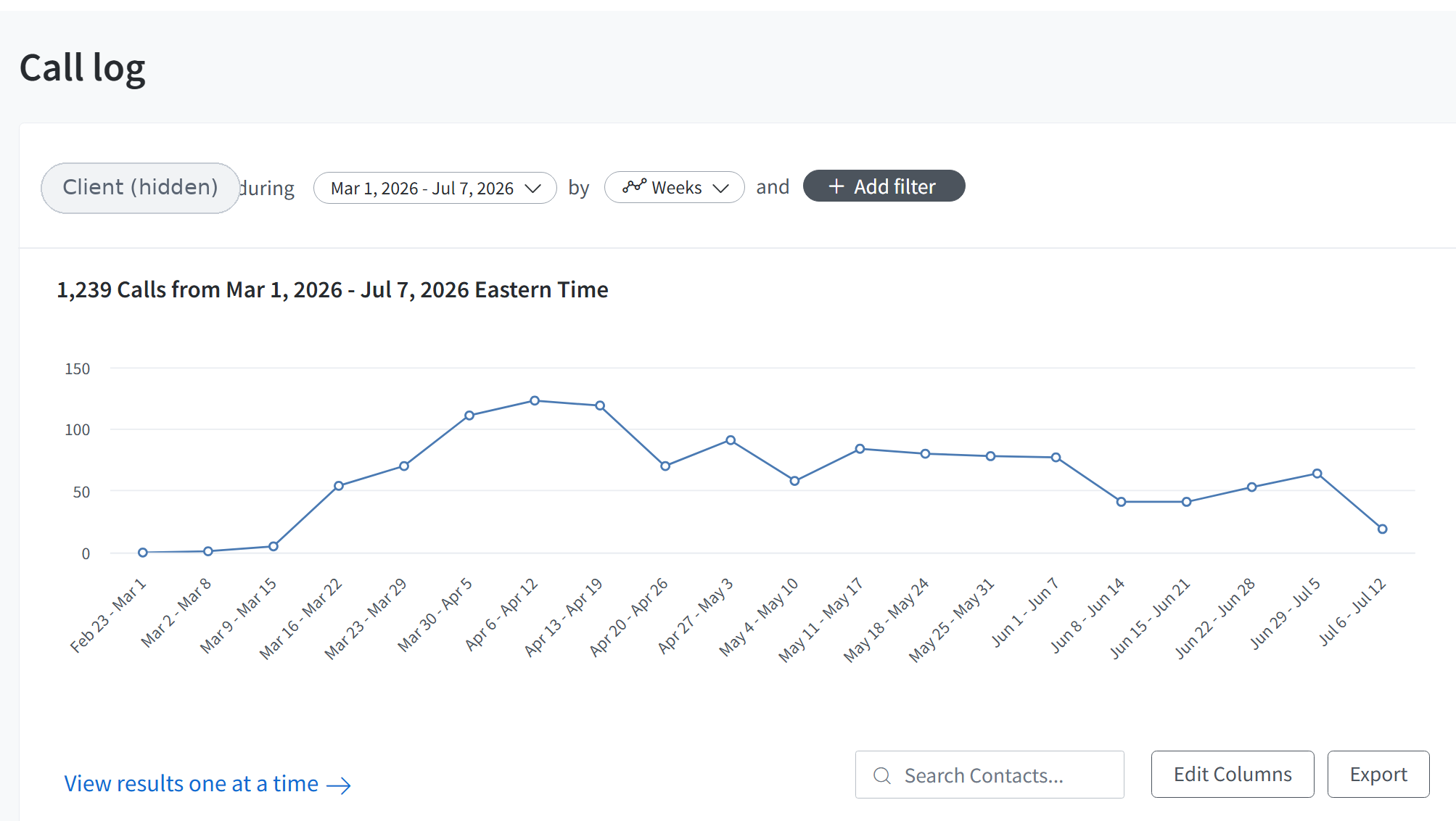
By the week of April 6 the account was producing 124 calls in a single week, up from near zero in February. Then the phone rang for us instead.
“Can you slow the ads down a little? We’re running out of dumpsters.” The client, by phone, week five · lightly paraphrased
In nine years of doing this, that request was a first. We throttled spend to match fleet capacity, which is why the call curve below eases off after mid-April: not a performance dip, a deliberate governor. The campaign now runs at the pace the trucks can serve, and scales the moment capacity does.
Straight from the dashboards.
What a $15 lead means on an $800 ticket.
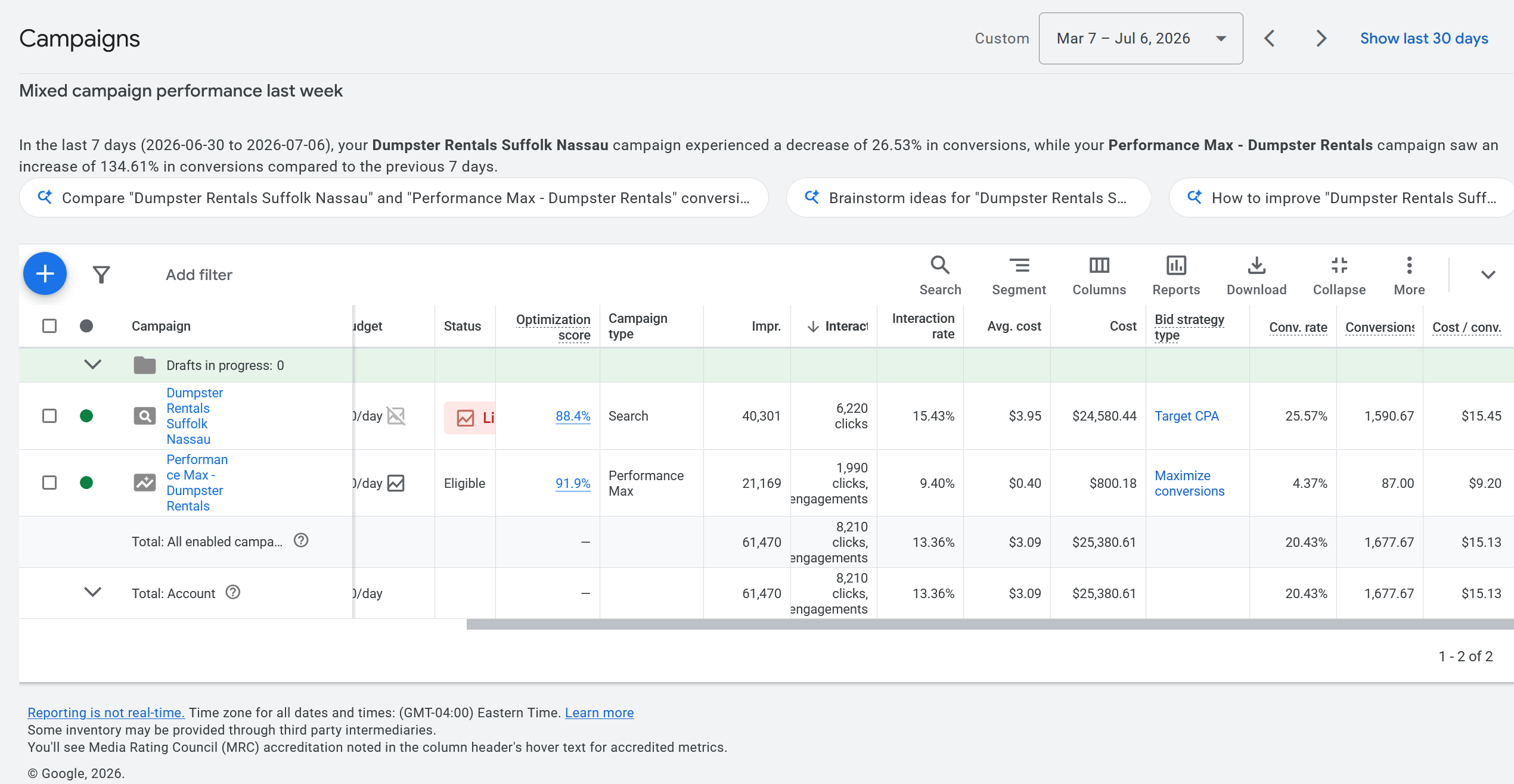
An average rental here runs about $800 for a week on the driveway. At $15.13 per lead, ten leads cost $151.30. Close just one of those ten, a close rate any decent dispatcher clears in their sleep, and the entire acquisition cost is under a fifth of a single average ticket. Before multi-week extensions. Before swap-outs. Before the contractor who rents four more this year.
The client’s actual close rate is their business to keep private. The point is the margin of safety: at these lead costs, the marketing does not need to be lucky to be profitable. It needs a truck available.
A second engine, already cheaper than the first.
In late June we layered a Performance Max campaign alongside Search. Early days, but the opening numbers are worth watching: $9.20 per conversion against the Search campaign’s $15.45, and conversions up 134% week over week in its first full comparison. If it holds at scale, the blended cost per lead falls further.
Growth is now paced by one variable, and it is the right one to be limited by: how many dumpsters are on the lot. When the fleet grows, the dial turns the same afternoon.